Making Email Verification Boring and Reliable: A Developer’s Guide
Kieran Goodary
Why does email verification need to be boring?
Email verification has a bad reputation for being complicated, flaky, and annoying-both for users and developers. But here’s the thing: if your email verification system works reliably and without friction, it becomes invisible. Nobody notices it, nobody complains, and, frankly, nobody talks about it. That’s exactly what you want.
Boring, reliable email verification means fewer abandoned sign-ups, smoother user experiences, and fewer support tickets. From a developer’s perspective, it means your automated tests don’t fail randomly, your CI/CD pipelines don’t get stuck hunting for emails, and your engineering team isn’t wasting cycles babysitting email delays or inconsistent OTP extractions.
So, the goal isn’t to make email verification exciting or flashy. It’s to make it completely unremarkable. Because when nobody talks about your email verification, you know you’ve nailed it.
Why are disposable or burnable inboxes useful for email verification testing?
Imagine you’re testing an app with email verification. You have to create a user account, receive an OTP or confirmation link, extract it, submit it back, and repeat this hundreds of times across different environments and runs.
You could use a shared Gmail inbox, but then you’re juggling permissions, rate limits, confusing shared inboxes, and flaky IMAP interactions. Parsing emails with brittle regular expressions adds another layer of headache-what if the format changes?
Disposable or burnable inboxes solve these problems neatly. They provide:
- Programmatic access: APIs to create inboxes on the fly and read messages, no logging in anywhere.
- Isolation: Each test can have a fresh inbox, so no contamination between runs.
- Fast, reliable access: Emails appear in the API quickly, making test runs predictable.
- OTP and link extraction out of the box: Some services detect OTP codes or verification links automatically, sparing you from maintaining regexes.
Using these inboxes means your end-to-end verification tests become deterministic, your test suites run smoothly in CI/CD, and you don’t need burly scripts to parse complex emails across varied formats.
How do disposable inboxes help protect user privacy in real-world applications?
Email addresses have become a scarce commodity that users are cautious about sharing-rightfully so. Throwing your real email everywhere invites spam, phishing attempts, and data leaks.
Disposable inboxes allow normal users to sign up for services without handing over their permanent email. They can create a temporary email to receive a confirmation or OTP and verify their identity without exposing their main inbox.
This approach not only shields users from unwanted emails but also enables smoother trial sign-ups and reduces barriers to testing or accessing content. Instead of signing up with your real email that you’ll immediately unsubscribe later, you just burn one.
From a privacy standpoint, encouraging this habit-or even integrating with disposable inbox acceptance on your platform-can reduce user friction and respect their data boundaries. After all, not every user wants to commit their primary email until they trust your service.
Why should engineering teams avoid shared Gmail accounts and brittle regex in email verification?
Using a shared Gmail for automated email verification in tests is like building a house on a swamp. It might stand for a while, but it’s shaky and full of hidden problems:
- Access and concurrency issues: Multiple tests or developers hitting the same inbox at once cause race conditions.
- Rate limits and security risks: Google can throttle connections or flag suspicious login attempts.
- Manual intervention: Sometimes inbox passwords change or two-factor auth annoys your CI pipeline.
On top of that, relying on fragile regular expressions to peel out OTP codes or links from email content is a maintenance nightmare. Email designs change, marketing templates get added, and suddenly your regex returns garbage or breaks tests.
An API-driven disposable inbox with built-in OTP/link extraction makes all this much smoother. The service handles email parsing, your tests just call APIs and assert on returned values. Better automation, less fragile code.
How can OTP extraction via an email testing API improve end-to-end authentication flows?
One of the most fiddly parts of building and testing authentication flows is dealing with one-time passwords (OTPs). They are time-sensitive, formatted variously, and critical to verify.
Manual intervention kills testing speed and kills the joy of automated pipelines. Enter APIs that automatically extract OTPs from incoming emails:
- You generate a disposable inbox for your test user.
- The app sends the OTP email.
- Your test code polls the API, which returns the OTP as a simple string.
- Your test submits the OTP to complete verification.
This process is seamless, fast, and repeatable. It eliminates flaky parsing, timing issues, and manual scraping. Your CI pipeline can validate auth flows end-to-end every time.
What role do webhooks play in making email verification more reliable?
Polling is fine, but polling forever waiting for verification emails adds time and unpredictability. Webhooks can flip the model: instead of your tests waiting, the inbox service pings you when an email arrives.
This makes test flows faster and more event-driven. As soon as the email comes in, your code grabs the OTP or link and proceeds. It’s like moving from a dial-up connection to broadband for your email verification.
Webhooks improve your pipeline speed, reduce test flakiness caused by timing, and allow more sophisticated integrations. For example, you can validate different flows, trigger further tests, or alert on any missing or unexpected emails instantly.
How do disposable inboxes integrate into CI/CD workflows?
Let’s face it: continuous integration and deployment pipelines hate surprises. Flaky tests, random failures, network issues-they cause delays.
Disposable inboxes with stable APIs and fast email delivery provide deterministic inputs and outputs for your tests:
- Spin up a disposable inbox dynamically during test setup.
- Trigger the email verification flow.
- Extract OTP or confirmation links automatically via the inbox API.
- Proceed with account activation or sign-in tests.
- Tear down inboxes at test end, keeping things clean.
This approach keeps your tests isolated, repeatable, and fast. You avoid delays from real mail providers, intermittent parsing failures, and locked credentials.
Can disposable inboxes help improve the user experience outside of testing?
Yes. Beyond tests and privacy shields, disposable inboxes can be designed into user flows for cleaner experiences.
For example, SaaS platforms offering free trials can encourage users to use disposable emails for quick access without cluttering their main inbox. Newsletters or community platforms can accept such emails without risking spam abuse.
They also help moderate usage policies-since disposable inboxes typically expose domain info or usage patterns, you can build smarter fraud detection and throttling.
However, accept them thoughtfully. Some businesses avoid disposable emails for security or legitimacy reasons. Balance flexibility with your product needs.
Summary
Making email verification boring and reliable isn’t about dullness-it’s about building a foundation so sturdy it fades into the background. Disposable inboxes, robust APIs, OTP extraction, and webhooks remove friction and uncertainty.
For developers, this means more reliable CI/CD, less flaky code, and automation that just works. For users, it means privacy, effortless sign-ups, and fewer headaches.
If there’s one lesson here: email verification should never be the reason your users or tests break. Make it boring. Make it reliable. Then, get back to building cool stuff.
If you want to explore programmatic disposable inboxes and APIs that make verification painless, check out tools like MailParrot that specialize in simple, dev-friendly email testing.
Ready to unblock your tests and pipelines?
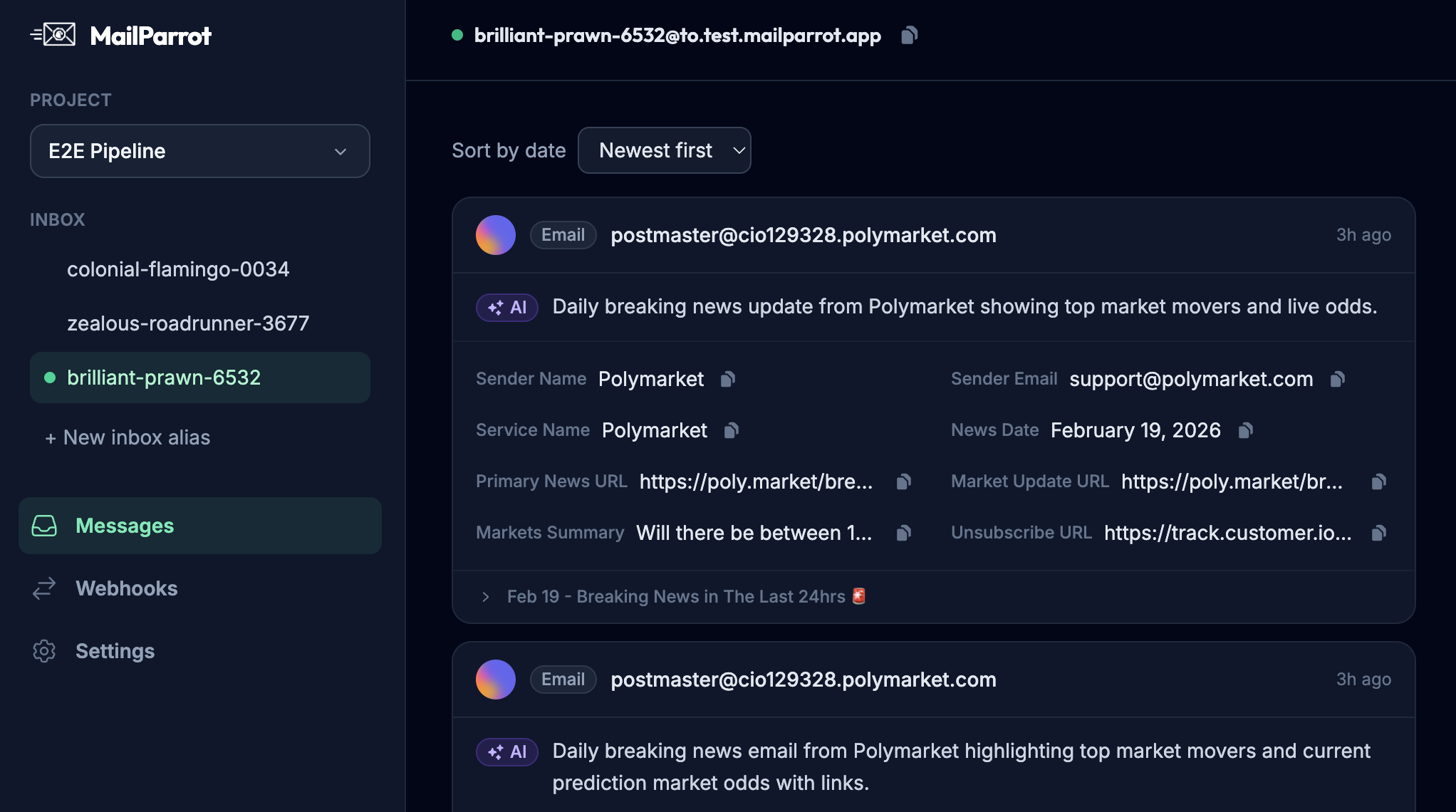
1,000 free credits with every account-no card required. They don’t expire.
Get started for free