How Disposable Email Addresses Protect Your Real Inbox
Kieran Goodary
What are disposable email addresses and why do they exist?
Disposable email addresses, sometimes called burnable or temporary emails, are email accounts created for one-time or short-term use. Think of them as the digital equivalent of a burner phone or a single-use ticket. They let you provide an email address without exposing your primary account.
The main idea is to give you an inbox that self-destructs after use or can be discarded without consequences. This way, you avoid spam, protect privacy, and keep your actual email clean and manageable.
Originally, disposable emails were a niche privacy tool, but nowadays, they’re leveraged widely by developers and product teams to streamline testing and by normal users to take back control of their email privacy.
How do disposable emails protect your real inbox from spam and junk?
The internet is rife with sketchy web forms and subscription traps. Use your main email every time you sign up and expect a daily flood of newsletters, promotional messages, or worse, spam from dubious sources. Disposable emails act as a buffer to catch all that unwanted noise.
By using a disposable address for sign-ups, newsletters, trials, or any situation you’re unsure about, you prevent your real inbox from being targeted. If the disposable email starts receiving spam, just toss it and create a new one. No spam farm reaches your real mailbox.
This not only keeps your inbox tidy but reduces the cognitive load – fewer unread messages, fewer distractions.
Can disposable emails help protect your personal privacy?
Absolutely. When you hand over an email address to a website or service, you’re often giving away a piece of your digital identity. This info can be sold, used to track you across the web, or pester you with targeted ads.
Using a disposable email protects your privacy by limiting the amount of real personal data you expose. It’s like showing up to a party in a disguise. You still participate but keep your real identity secure.
Moreover, for sensitive activities—such as signing up for forums, online giveaways, or potentially untrustworthy services—a disposable email can prevent your personal address from leaking in data breaches.
Why are disposable emails useful for product and engineering teams?
Beyond personal use, disposable emails play a huge role in product development and testing. If you’re building software that sends emails – think signup confirmations, password resets, or one-time passwords (OTPs) – you need a reliable way to verify email workflows.
Manually using your real inbox for tests is error-prone and inconvenient. Plus, sharing a single email address among team members leads to chaos, mishandled messages, and brittle regex filters trying to parse real emails.
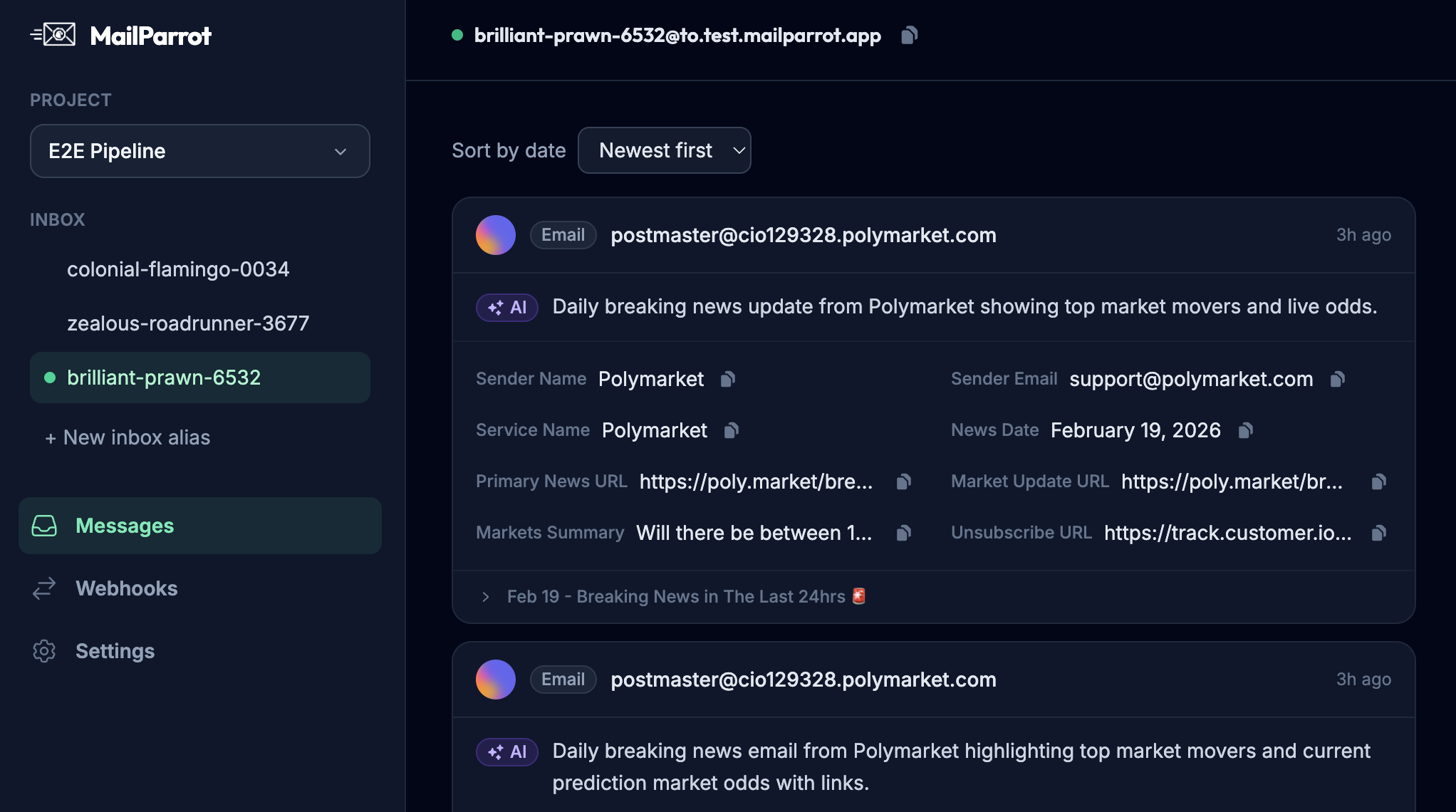
Disposable email addresses, especially when programmatically accessible through APIs like MailParrot’s, provide isolated, one-time-use inboxes. This means you can spin up hundreds of test addresses, automate extraction of OTPs or verification links, and validate email flows in your CI/CD pipelines without ever touching your real inbox.
How do disposable inbox APIs simplify OTP extraction and webhook automation?
One particularly annoying aspect of testing authentication flows is grabbing OTPs or magic links from incoming emails. Traditionally, this involved parsing a shared mailbox with fragile regular expressions that often broke with minor email template changes.
Disposable inbox APIs provide structured access to email content in JSON format. They can watch an inbox in real-time and trigger webhooks the moment an OTP arrives. This reduces test flakiness and dramatically speeds up your end-to-end (e2e) tests.
Also, no more vetting messy, shared Gmail inboxes full of unrelated emails. Each disposable inbox is scoped to the test run or developer, making debugging straightforward.
Why is relying on shared Gmail addresses and regex parsing a bad idea?
Many teams default to a shared Gmail account to test email flows, then try to parse emails with fragile regular expressions. It’s the digital equivalent of duct-taping a spaceship together.
Shared inboxes lead to race conditions when tests run concurrently, lost or overwritten emails, and overall uncertainty about email state. Regex parsing is brittle—slight changes in email layout or content often cause extraction failures.
Disposable inbox APIs sidestep these issues by giving each test a fresh, dedicated inbox and a structured way to access email content. You get reliability, scalability, and accuracy without awkward hacks.
How do disposable emails make email verification boring and reliable?
Email verification – sending a code, link, or OTP – is fundamental but rarely exciting. Yet, when email verification is flaky or breaks in production, customers notice immediately, churn spikes, and support tickets pile up.
Disposable email solutions enable teams to automate continuous testing of these flows. By simulating real-world email reception, extracting codes, and verifying user authentication automatically, you turn a potentially fragile step into a boring, rock-solid part of your application.
Ensuring that your email verification is reliable means users don’t get stuck in signup loops or frustration, improving conversion and user satisfaction.
Can disposable emails help normal users beyond developers?
Yes. Not everyone writing with disposable emails is a developer (though if you’re reading this, chances are high you are one).
Normal people use disposable emails to protect privacy, quickly sign-up on new platforms without committing their main email, and start free trials or downloads risk-free. This habit limits spam and improves digital hygiene.
Services like MailParrot ensure the disposable addresses are developer-friendly but also user-friendly: quick to create, easy to forget, and disposable at any moment.
Are disposable emails just for testing or can they be used long-term?
It depends. Disposable emails usually aren’t designed for long-term communication. They typically have a short lifespan (minutes to days).
For testing, that’s perfect—spin up an address, receive verification, destroy it.
For personal use, they’re great for one-off sign-ups or temporary use but not ideal if you want persistent access, password resets, or long-term correspondence.
If you find yourself relying on disposable emails all the time for critical accounts, it might be worth considering dedicated secondary emails or email aliases.
How do you get started with disposable email APIs like MailParrot?
If you’re a developer building apps that involve emails, disposable inbox APIs like MailParrot make your life easier. They provide endpoints to create inboxes on demand, programmatically fetch messages, extract OTPs, and hook into webhooks for event-driven workflows.
Getting started typically involves:
- Signing up for an API key
- Creating inboxes via the API
- Waiting or polling for emails to arrive
- Parsing or extracting needed information (OTP, links)
- Cleaning up inboxes when done
This setup fully automates what was once a painful manual process, integrating seamlessly into CI/CD pipelines and automated tests.
Final thoughts: disposable emails are a developer and user’s privacy ally
Disposable emails are far more than just a spam filter—they’re a crucial tool for anyone wanting to protect their real inbox, maintain privacy, and build reliable software that deals with email.
By embracing disposable inbox APIs, developers can toss brittle hacks, save time, and reduce test flakiness. Users gain confidence when signing up for services, free trials, or forums without exposing their digital life.
If you haven’t started using disposable emails in your workflows yet, it’s time to give your inbox a break. Your email deserves better.
Ready to unblock your tests and pipelines?
1,000 free credits with every account-no card required. They don’t expire.
Get started for free